Defying expectations that it would dial back its use of National, Regional and/or Local Emphasis Programs, OSHA has once again extended and updated another key inspection targeting program. Having already announced extensions to the Hazardous Machinery (Amputations) and Heat Illness NEPs, OSHA recently released an updated directive, effective July 31, 2026, for the agency’s NEP on Warehousing and Distribution Center Operations. The new directive extends the NEP through July 2031, reflecting OSHA’s continued commitment to identifying and mitigating significant health and safety risks associated with the continued nationwide growth of warehouse and distribution center operations.
Originally launched in July 2023, the Warehousing NEP was designed to address rising injury and illness rates tied to the rapid expansion of warehouse and distribution center operations over the past decade, accelerated by the explosive growth of e-commerce, rapid advances in automation, and evolving regulatory demands. Estimated employment in the U.S. warehousing and storage industry has more than doubled over the past decade, rising from 882,100 to 1,836,200 between 2015 and 2025. According to OSHA, the rapid growth in job opportunities has been accompanied by a corresponding rise in nonfatal occupational injuries and illnesses. Indeed, OSHA explains that from 2020 through 2024, the five-year average Days Away, Restricted, or Transferred (DART) incident rates for employees in warehousing and distribution center operations, mail processing and distribution centers, courier and express delivery services, and local messenger and delivery industries exceeded baseline private general industry rates.
What Has Changed Under the New Directive?
In addition to extending the program through July 2031, the updated directive includes the following significant changes:
- Removed coverage for High Injury Rate Retail Establishments.
Under the 2023 NEP, “high-injury retail establishments” referred to certain retail businesses with particularly high average DART rates, including home centers, hardware stores, building material dealers, supermarkets, grocery stores, warehouse clubs, and supercenters. The original NEP required partial inspections of these facilities’ loading docks and storage areas, while allowing OSHA to expand the inspection if evidence of violative conditions appeared elsewhere in the establishment. The updated guidance removed coverage for these high-injury retail establishments.
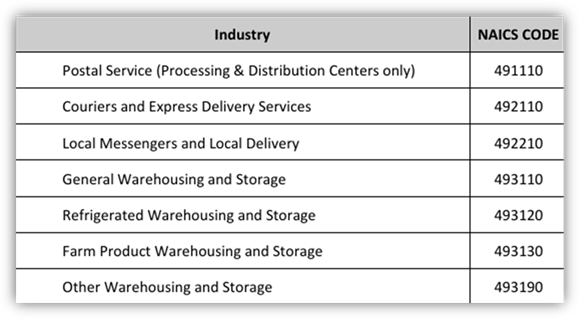
Employers in the following specific warehouse industry segments remain covered by the renewed NEP:
- Removed mandatory screening for ergonomic and heat hazards.
Under the 2023 NEP, heat and ergonomic hazards had to be evaluated during all warehouse and distribution industry inspections, and if heat-related hazards were identified, OSHA inspectors were obligated to expand the inspection scope in accordance with the NEP for Outdoor and Indoor Heat-Related Hazards (Heat NEP) and initiate a health investigation. Similarly, if worker exposure to ergonomic hazards was identified during the review of the employer’s injury and illness logs, worker interviews, or the establishment walkthrough, OSHA inspectors were directed to expand the inspection scope and initiate a health investigation. In a significant revision to the NEP, the updated directive removes these mandatory assessments. Covered employers should note, however, that compliance officers may still attempt to expand the scope of an NEP inspection if they observe what they believe to be heat and/or ergonomic hazards during their inspection.
Indeed, this change does not eliminate OSHA’s broader focus on heat exposure, as employers within 55 high-risk industries remain covered by OSHA’s Heat NEP, including the warehousing and storage industry.
- Clarified Area Office discretion to expand inspections based on fatalities, catastrophes, complaints, or referrals related to establishments in covered NAICS codes.
The renewed NEP makes clear that its guidance and inspection parameters are not intended to operate as rigid boundaries or constraints. Whereas the prior NEP required inspectors to expand inspections when specified circumstances were present, the renewed directive expressly notes Area Offices’ discretion to expand the scope of an inspection in response to fatalities or catastrophes, complaints, referrals, or other information indicating additional hazards in the warehouse or distribution industry.
This distinction gives Area Offices greater flexibility to tailor inspection scope based on the specific facts presented, rather than requiring expansion whenever predefined conditions are met.
- Changed OIS coding to “WAREHOUSE.”
The revised NEP also makes a minor administrative change, replacing the prior “WAREHOUSE23” OIS designation with a new standardized identifier: “WAREHOUSE.”
Employer Takeaways
As the warehouse and distribution industry continues to rapidly expand nationwide, the renewed NEP makes clear that OSHA’s scrutiny will expand alongside it. By extending the program and giving inspectors greater discretion to determine the scope of investigations – and, consequently, where the agency directs its enforcement resources – OSHA has positioned the NEP as a sustained enforcement framework designed to identify hazards, encourage compliance, maintain oversight, and address the rise in workplace injuries and illnesses that has accompanied the industry’s extraordinary growth.
Topics
Related Practice Areas
Share This
Related People