
This Monday, April 6, 206, OSHA issued a Notice of Proposed Rulemaking to eliminate a compliance deadline to install personal fall arrest/ladder safety systems on fixed ladders over 24 feet tall (i.e., the requirement to replace all existing tall fixed ladders that are equipped with ladder cages and wells with ladders with integrated harness/lanyard systems by 2036).
Comments in response to the NPRM are due June 5, 2026. OSHA has also committed to holding a public hearing, if one is requested by any interested stakeholder.
OSHA’s 2016 Walking-Working Surfaces rule unexpectedly required employers to outfit all fixed ladders with a continuous run of more than 24 feet, with personal fall arrest or ladder safety systems; OSHA would no longer permit employers to continue their longstanding and effective reliance on ladder cages and wells for fall protection on these tall fixed ladders. Last summer, Conn Maciel Carey LLP’s OSHA Practice petitioned OSHA to initiate a rulemaking to revisit that requirement on behalf of its Employers OSHA Modernization Coalition and the American Fuel and Petrochemical Manufacturers Association, the American Petroleum Institute, and the American Chemistry Council. Specifically, the industry groups petition OSHA to permit employers to continue relying on ladder cages and wells for fall protection on fixed ladders. Here’s a link to the rulemaking petition.
Last September, OSHA signaled its initial openness to our petition in a public memorandum stating that it would propose to revise the standard (29 C.F.R. 1910.28(b)(9)(i)(D)) to eliminate the final compliance deadline for existing ladders, and require the installation of personal fall arrest systems/ladder safety systems only when employers install new ladders or the existing ladders reach the end of their service lives.
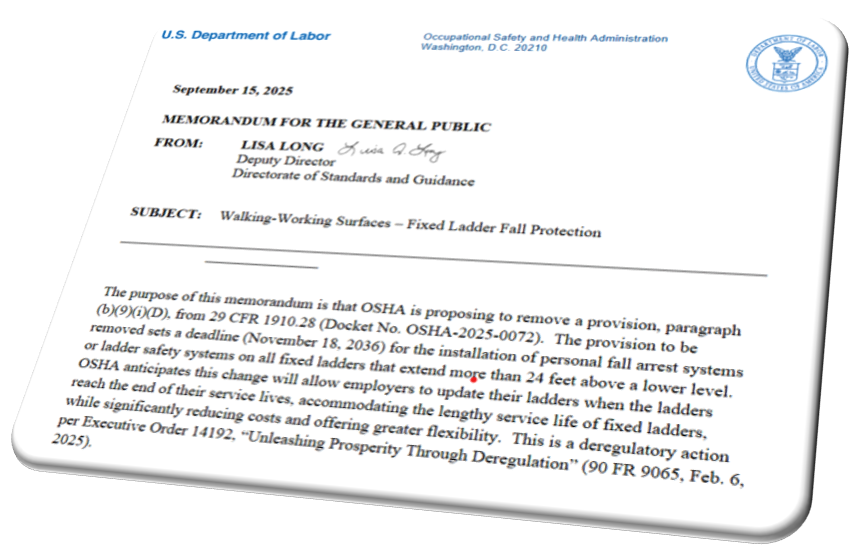
Over the Winter, OMB held a series of EO 12866 stakeholder meetings, at which Industry supported OSHA’s decision to reopen the rulemaking record to address the ladder fall protection requirements and encouraged the Administration to go further than the public memorandum suggested, and instead fully rollback the exclusion of ladder cages and wells as compliance options even for new and replacement ladders.
Earlier this week, on April 6, 2026, OSHA officially published the NPRM to modify the requirement that employers install a personal fall arrest system/ladder safety system on fixed ladders over 24 feet by November 18, 2036. As the agency signaled last Fall, it is proposing to eliminate the compliance deadline, but still requires retrofitting the ladders:
“When a fixed ladder, cage, or well, or any portion of a section thereof, is replaced, a personal fall arrest system or ladder safety system is installed in at least that section of the fixed ladder, cage, or well where the replacement is located.”
The proposal does not, at this time, propose to rescind the related requirements to install personal fall arrest/ladder safety systems on new fixed ladders and existing ladders that require substantial repair or replacement, however, the NPRM explicitly calls for input about whether OSHA should do so; i.e., adding personal fall arrest/ladder safety systems to the list of compliant options along with ladder cages and wells. However, significantly, OSHA also requested comments on:
“Whether it should repeal or revise the requirement that employers use personal fall arrest systems on all fixed ladders over 24 feet.”
In this NPRM, OSHA explained that in 2016, when it adopted the personal fall arrest/ladder safety system rule with the 2036 deadline, it assumed that most fixed ladders would be replaced within that 20-year period and that employers would therefore come into compliance with the new rule during the normal course of replacing their ladders. OSHA now states that it does not know whether that is true. OSHA also acknowledges that it cannot attribute any reduction in injuries/fatalities specifically to the personal fall arrest/ladder safety system requirement. And OSHA acknowledged that, based on the information in the petition for rulemaking last summer, it expected the proposal to result in significant cost savings for the US economy (measured in the billions of dollars).
Now employers will have an opportunity to provide OSHA with additional evidence supporting the elimination of the compliance deadline and preserve the right to use ladder cages and wells for all tall fixed ladders. OSHA has requested comments addressing several specific issues:
- The service life of fixed ladders over 24 feet and details used to evaluate factors affecting the remaining service of these ladders;
- Why the 2016 cost estimates and the costs claimed in the industry petition are so different, including assumptions regarding the extent to which ladder safety and personal fall arrest systems are already installed on fixed ladders above 24 feet;
- The compliance cost estimates raised in the petition last summer for identifying, assessing, and retrofitting fixed ladders;
- Accuracy of OSHA’s estimate of cost savings that would result from eliminating the November 18, 2036, deadline;
- Installation costs of ladder safety systems and personal fall arrest systems on fixed ladders over 24 feet in height in other industries (mainly outside of petroleum refining and chemical manufacturing);
- The number of fixed ladders that might be affected by this proposed rule;
- Information about current fall protection on fixed ladders;
- Details about costs already incurred or saved, including cost or cost savings per worker, per process unit, or per production operation;
- Any technological, economic, and safety-related impacts of the proposal; and
- Whether OSHA should repeal or revise the personal fall arrest/ladder safety system requirement for fixed ladders, including:
- Whether cages and wells provide equivalent safety outcomes compared to personal fall arrest systems or ladder safety systems across relevant industries and ladder configurations
- Costs and benefits of cages, wells, and personal fall arrest systems, and ladder safety systems
These requests for comments are an excellent opportunity for Industry to strengthen the safety and business case for the effectiveness of ladder cages and wells. OSHA’s request for comments from other industries not represented in the initial petition is also an excellent opportunity for more industries to impact this rule.
If you have any questions about this rulemaking or would like to learn more about participating in CMC’s Employers OSHA Modernization Coalition, contact Eric J. Conn.