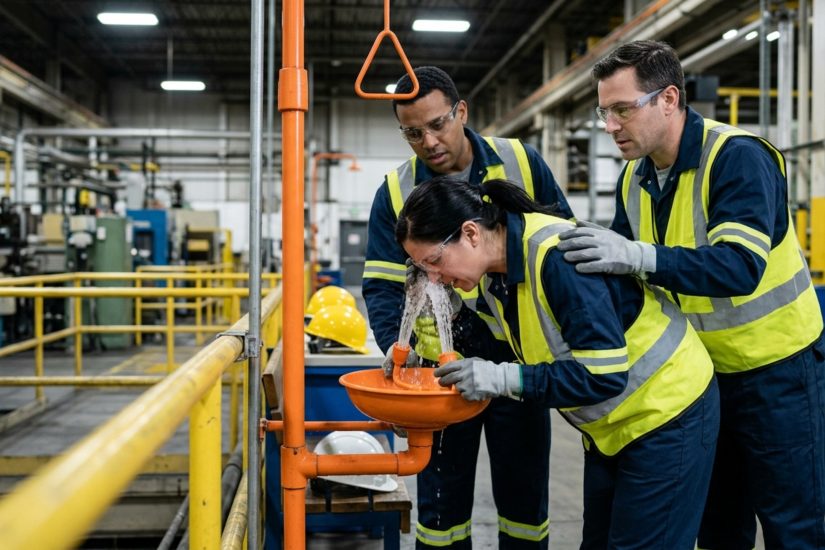
Many employers think emergency eyewash stations are only needed in chemical plants or factories. However, OSHA’s requirements can apply in any workplace where employees might be exposed to harmful corrosive materials. This includes places like warehouses, distribution centers, retail stores, labs, maintenance shops, healthcare facilities, and battery charging areas. While OSHA’s rule is brief, enforcement can be complicated because OSHA often uses other standards and specific regulations to decide if an employer’s eyewash equipment is adequate.
Understanding when eyewash stations are required, where they must be located, and how they must be maintained is critical because eyewash-related citations are frequently classified as a Serious violations and often act as the focal point during inspections involving chemical exposures.
The OSHA Standard That Requires Emergency Eyewash Stations
The primary federal OSHA requirement appears in 29 C.F.R. § 1910.151(c), which states:
Where the eyes or body of any person may be exposed to injurious corrosive materials, suitable facilities for quick drenching or flushing of the eyes and body shall be provided within the work area for immediate emergency use.
Although the rule is only one sentence, OSHA’s enforcement of it turns on four key elements:
- Exposure to injurious corrosive materials
- Suitable facilities for flushing or drenching
- Availability within the work area
- Access for immediate emergency use
Similar requirements apply in construction and maritime workplaces. Construction employers, for example, should also review 29 C.F.R. § 1926.50(g).
State OSHA Considerations
States that run their own OSHA-approved programs (State Plans) may impose additional or more specific requirements. California provides one well-known example through Cal/OSHA Title 8 § 5162, which contains detailed emergency eyewash and safety shower provisions. Employers operating in state-plan jurisdictions should review both federal requirements and any state-level regulations that may exceed federal OSHA requirements.
What Chemicals Trigger OSHA Eyewash Station Requirements?
OSHA usually evaluates corrosive hazards based on the Hazard Communication Standard and the Safety Data Sheet (SDS). Employers should focus on the following:
- SDS Section 2 (Hazard Identification)
- SDS Section 8 (Exposure Controls/Personal Protection)
- Skin Corrosion Category 1 classifications
- Serious Eye Damage classifications
- Extremely acidic or caustic substances
If a chemical can seriously injure eyes or burn skin on contact, you may need an emergency eyewash station.
There Is No Minimum Quantity Exception
A common misconception is that only large quantities of corrosive chemicals trigger the rule. The standard contains no minimum threshold. OSHA has consistently taken the position that even relatively small quantities of corrosive materials can require emergency flushing facilities if employee exposure is reasonably foreseeable.
Closed Systems Do Not Automatically Eliminate the Requirement
Employers sometimes assume that chemicals enclosed in piping systems, tanks, or equipment eliminates the need for emergency eyewash equipment. In practice, OSHA focuses on employee exposure during tasks that open the system, including:
- Sampling operations
- Maintenance activities
- Line breaks
- Battery handling
- Valve replacement
- Spill response
- Equipment charging or servicing activities
The key question is whether employees can come into contact with corrosive materials during normal or reasonably anticipated work activities.
PPE Does Not Replace Emergency Eyewash Equipment
OSHA generally does not accept safety glasses, goggles, face shields, or other protective gear as replacements for emergency eyewash stations. Even if employees wear the right PPE, you may still need emergency flushing stations if there is any chance of exposure to corrosive materials. PPE lowers the chance of a splash reaching the eyes, but it can’t remove a chemical once contact occurs.
Substance-Specific OSHA Standards with Additional Eyewash Requirements
Several OSHA standards contain eyewash or drench shower requirements beyond the general provisions found in 1910.151(c). These include:
- Formaldehyde (29 CFR 1910.1048) – Employers working with formaldehyde may have specific eyewash and shower obligations depending on concentration levels.
- Methylene Chloride (29 CFR 1910.1052) – This rule also requires emergency washing and flushing if the exposure risk is present.
Forklift Battery Charging Areas
OSHA often checks battery charging areas under both 1910.151(c) and the rules for powered industrial trucks. Battery acid is corrosive, and splashes or spills can occur during charging, watering, and battery changes, so this is a common issue during inspections.
OSHA Enforcement and ANSI/ISEA Z358.1
Employers should understand that OSHA has not formally adopted ANSI/ISEA Z358.1 as an OSHA regulation. However, OSHA routinely relies upon ANSI’s requirements when determining whether an eyewash station constitutes a “suitable facility” under 1910.151(c).
In practice, employers should assume OSHA compliance officers will evaluate eyewash stations against ANSI criteria during inspections. Employers frequently discover that equipment they believed was adequate fails OSHA scrutiny because it does not satisfy established performance expectations relating to:
- Water flow
- Duration
- Accessibility
- Activation
- Maintenance
- Employee usability during an emergency
Selecting the Correct Type of Emergency Equipment
The type of hazard will decide what emergency equipment you need:
| Hazard Type | Equipment Typically Required |
|---|---|
| Eye exposure only | Eyewash station |
| Eye and facial exposure | Eye/face wash station |
| Significant body exposure | Drench shower |
| Multiple exposure risks | Combination eyewash and shower unit |
Bulk handling of corrosive chemicals often requires more than an eyewash station alone. In many situations, a safety shower is also necessary.
Accessibility Requirements
OSHA inspectors often pay close attention to whether eyewash stations are easy to reach. Here’s what compliant and non-compliant access typically look like:
| ✅ COMPLIANT ACCESS | ❌ NON-COMPLIANT ACCESS |
|---|---|
| Reachable within approximately 10 seconds | Storage or pallets blocking access |
| Located on the same level as the hazard | Eyewash station located on another floor |
| Clear and unobstructed travel path | Locked or latched doors in travel path |
| No locked, latched or blocked doors | Excessive travel distance |
| Clearly marked and adequately illuminated | Poor visibility or inadequate signage |
| Immediately available for emergency use | Equipment or machinery obstructing access |
Note: For highly corrosive acids and caustics, immediate adjacency to the hazard may be necessary.
Flow Rate and Flushing Duration
ANSI performance criteria generally require:
- Eyewash stations: 0.4 gallons per minute
- Eye/face wash stations: 3.0 gallons per minute
- Drench showers: 20 gallons per minute
The equipment must generally provide continuous flushing for 15 minutes. Sink faucets, ordinary hoses, and improvised solutions often fail to meet these performance expectations.
Hands-Free Operation
Emergency eyewash equipment should activate quickly and remain on without requiring the user to continuously hold a control open This requirement illustrates a practical reality: employees often need both hands free to hold their eyelids open while flushing their eyes.
Tepid Water Requirements
Water temperature matters. ANSI guidance generally calls for “tepid” water, typically between 60°F and 100°F.
Employers often address this requirement through:
- Thermostatic mixing valves
- Heat tracing
- Freeze protection systems
- Outdoor unit protection measures
Portable Eyewash Station Requirements
Where plumbing is unavailable, self-contained or portable eyewash stations may be acceptable.
To satisfy OSHA expectations, portable units generally must:
- Deliver required flow rates
- Provide sufficient flushing duration
- Be maintained according to manufacturer instructions
- Have fluid changed or treated as required
- Remain readily accessible during emergencies
Importantly, personal eyewash bottles and squeeze bottles are typically considered supplemental equipment rather than substitutes for a compliant emergency eyewash station.
Inspection and Maintenance Requirements
Although OSHA’s regulation does not specify an inspection schedule, inspectors frequently expect employers to follow ANSI maintenance recommendations.
Best practices include:
| Weekly Inspections | Weekly Checks for Portable Units | Annual Evaluations |
|---|---|---|
| Activate plumbed units weekly | Verify fluid levels | Conduct full inspections against requirements |
| Verify proper flow | Inspect expiration dates | Verify performance standards |
| Remove sediment buildup | Confirms treatment solutions still are effective | Review signage and availability |
| Flush stagnant water from lines | Confirm employee training remains current |
Documentation matters. During inspections, compliance officers commonly request inspection records and service records. A documented inspection program can be just as important as the equipment itself. Without records, employers have little evidence that their equipment has been maintained.
Common Eyewash Station Violations OSHA Inspectors Cite
Based on OSHA enforcement trends, employers frequently receive citations for:
- Eyewash stations blocked by storage
- Stations located on a different floor from the hazard
- Inoperable or poorly maintained units
- Clogged nozzles or inadequate flow
- Missing inspection records
- Improvised flushing methods
- Reliance solely on squeeze bottles
- Employee training deficiencies
- Failure to evaluate eyewash capabilities during battery charging or corrosive-material operations
Lessons Employers Can Take from Recent Battery-Charging Enforcement Activity
Recent enforcement activity emphasizes multiple repeated problems involving battery charging operations. OSHA has progressively focused on whether employees may encounter sulfuric acid through spills, leaking batteries, cleanup activities, battery handling, or equipment maintenance. OSHA has additionally scrutinized whether emergency flushing equipment can actually deliver continuous, hands-free flushing consistent with accepted industry standards.
At the same time, employers have argued that not every battery charging operation creates exposure to injurious corrosive materials, particularly where batteries remain sealed and charging occurs without electrolyte handling. These differing positions illustrate an important point: eyewash station compliance is often highly fact-specific and depends on the actual exposure situations present in the workplace.
Employers should therefore evaluate not only the chemicals present in the facility, but also the work activities that could create a splash, spill, leak, or cleanup exposures.
Conclusion
OSHA eyewash station requirements go well beyond installing equipment on the wall. Employers must assess chemical hazards, provide appropriate emergency flushing equipment, ensure rapid accessibility, maintain the equipment properly, and train employees on its use.
Because OSHA often relies on ANSI/ISEA Z358.1 when evaluating compliance, employers should review their eyewash stations through both the OSHA regulation and the industry consensus standards used during enforcement. A proactive assessment can help reduce employee injury risks and avoid costly citations when OSHA arrives on site.